AI-led legacy modernisation
For years CTOs have had to split one budget between keeping systems alive and building what is next. With legacy, that was never a fair trade: the older a system gets, the more it costs to run, quietly draining the money meant for growth. AI has changed that equation. Modernisation can now be faster and lower risk, enough to reset the balance: run costs fall, the change budget is freed, and AI becomes a lever rather than another line on the run bill.
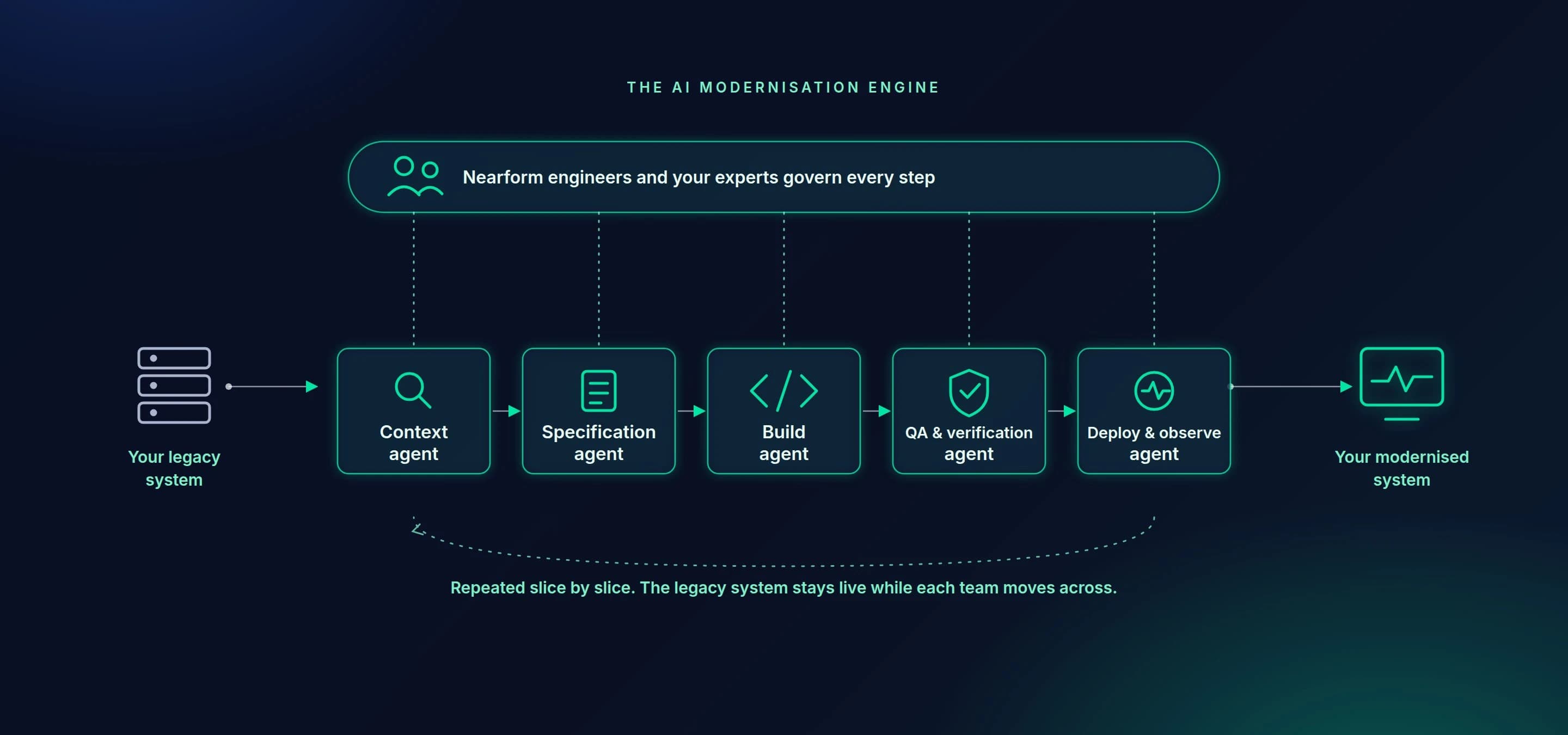
How it works
From liability to a platform you own
We call it 3-3-3: three phases that take a legacy system from unknown risk to a modern platform you understand and control.
- Assess
We map the system and its boundaries, agree the target state, and find the people who actually know how it works. This sets the scope before anything gets built.
- Validate
AI reverse-engineers the existing behaviour into clear, testable specifications and builds a first working slice against live data. Your experts confirm each spec and prove it matches before we build further.
- Scale
AI moves the rest of the system across, increment by increment, testing and checking at every step. Your team signs off each one. Humans stay in charge of every decision, exception and release.
Outcome
A platform you understand, own and can build on
Costs less to run and to change
Work that took months now takes days. The maintenance drag disappears, and modern infrastructure does more with less.
Stronger, more reliable, more secure
An actively maintained, patchable stack replaces one quietly accumulating vulnerabilities. Problems get caught before your users feel them.
Knowledge captured for good
What AI recovers becomes documentation and tests your business owns — not something that lives in one person’s head.
Your team freed to build, not maintain
Engineers and budget move from keeping the lights on to creating new value. And your AI ambitions finally have clean data to work with.
Tell us where you are today. We’ll show you what a safe path to modernisation looks like for your systems - and where to start.