There’s a certain kind of energy you feel when you go to speak on a panel and immediately sense that people are hungry for the conversation you’re about to have.
That was the atmosphere at Ireland House during SXSW - there were hundreds of engineers, designers, founders and business leaders from all around the world, ready to dive straight into the messy, exhilarating reality of AI adoption.
I hadn’t been to SXSW since 2019, before anyone had even heard the words “COVID”, “GPT” or even “aura farming.” Since then, SXSW has been through its own post-pandemic recovery, people outside of the tech bubble began using “Chat” in their everyday lives, and the majority of my LinkedIn feed now seems to be offering various forms of AI expertise.
That’s why, when walking up to the stage to talk about the reality of AI getting to production, instead of the hype, what struck me most was the level of engagement. There was such a mix of people in the audience, from all around the world, but there was leaning forward, note-taking and silent nodding that I haven’t really experienced since those years ago. After our on-stage conversation, I couldn’t believe the number of engineers from so many countries who came up to share a version of the same sentiment: “We’re living this too”.
Some referenced their own shift from pyramid-shaped teams to a diamond model, others were relieved to hear someone say out loud that senior engineers aren’t going anywhere and, in fact, are becoming more important as AI accelerates the base layers of delivery. Honestly, it felt less like a panel and more like a collective exhale. It was a moment of shared understanding in an industry that’s trying to build something entirely new. Yes, the ground is shifting beneath our feet, but that just means there’s uncharted land that we’re all discovering, in real-time.
For me, that’s the most exciting part of this moment in AI. It feels like the wild west. It’s messy and full of unknowns, but everyone’s learning together. No one person or organisation has all the answers, and in such an environment, transparency and collaboration matter far more than polish. It reminds me of why I love Nearform’s open source-influenced culture: the idea that learning in public, sharing breakthroughs and failures with equal enthusiasm, is what pushes an entire ecosystem forward.
We’re all learning as we go
A story that stuck with me was told by a fellow panelist from FedEx, who talked about how any corporate employee, technical or not, can now build internal AI agents using their in-house, no-code library. This is an organisation that “touches 99% of the world’s GDP” she pointed out, so the margin for error is minimal. Yet she was candid about the entire organisation learning as they go, openly admitting missteps and iterating along the way. That humility paired with ambition - and a laser focus on end user needs - is exactly the mindset enterprises need.
Now, most organisations don’t struggle with AI because of bad tools, but because they try to adopt AI as if it were just another tool. They may drop an assistant onto someone’s desktop and assume transformation will happen. But genuine impact requires much more, as we need to rethink the operating model, how individuals are incentivised and how teams are structured, how data pipelines are connected and ultimately architected and governed. It’s not the AI alone, but rather the ‘human plus AI interaction’, that needs to be carefully designed.
So, how is the rest of the world approaching AI?
One interesting theme that came up quite a bit at SXSW was the difference in how various regions are approaching AI. The contrast between the US and Europe was impossible to ignore. Many in the room expressed the view that American enterprises are moving faster, experimenting more boldly and integrating AI deeper into everyday workflows.
But Europe has something the US doesn’t yet: structure. More guardrails, clearer regulatory momentum, and even a push towards mandated AI literacy. It’s ironic, in a way: the US seems to be ‘winning’ on speed, but the EU may be building a stronger foundation for the long-term.
Testing in the age of uncertainty
Another lesson from the event was that traditional approaches to software testing simply don’t hold up anymore. We’ve spent decades building engineering cultures around deterministic systems and environments where the same input produces the same output, and quality can be validated with binary pass/fail checks. But AI breaks that paradigm.
Large language models and agentic systems are non-deterministic, and even with temperature turned to zero, the model can produce different phrasings, tool call sequences or reasoning paths on different runs. That means familiar safety nets - unit tests, integration tests, UI automation - are no longer sufficient. Instead, it requires an evolution in the entire discipline of testing. This may be one of the most underestimated shifts organisations face, especially those that have faced challenges in making the leap from AI in POC to AI in production.
Indeed, to build AI systems that behave reliably at scale, teams need evaluation frameworks, not just test suites. They also need expanded edge case testing - far beyond what they’re used to with deterministic systems.
A new beginning may mean saying goodbye, too
When a discipline reinvents itself as quickly as AI has for all of digital technology, it inevitably raises questions about what it means for engineering roles, and all of this change makes many people nervous that some may lose their jobs if they don’t adapt and evolve.
But I (as did a lot of the room), pushed back on the myth that ‘AI will replace engineers’. If anything, AI is making senior engineers even more important. As models take on more of the mechanical coding, humans become like orchestra conductors - managing agents and people alike, determining specs, identifying patterns, flagging risks and taking a system-level perspective for not only productivity but also safety.
I left SXSW feeling more optimistic than ever (despite my sore feet and hoarse voice). Not because the challenges surrounding AI aren’t real – they’re enormous – but because the willingness to tackle them collectively is growing, and fast. Companies are beginning to accept that success won’t come from chasing the latest model upgrade or vibe coding yet another demo.
It will come from designing systems that are observable, trustworthy and integrated into real workflows, from empowering teams rather than overwhelming them, and from adopting AI, not as a new way of building. And above all, from understanding that no one (yes, no one), has AI fully figured out. Which means everyone is still invited to help shape what comes next. And it can be anyone - from any country, any background - who has the ingenuity and creativity to find new solutions for these nascent challenges.
If this is the wild west, then SXSW proved one thing: we’re all playing pioneer together.
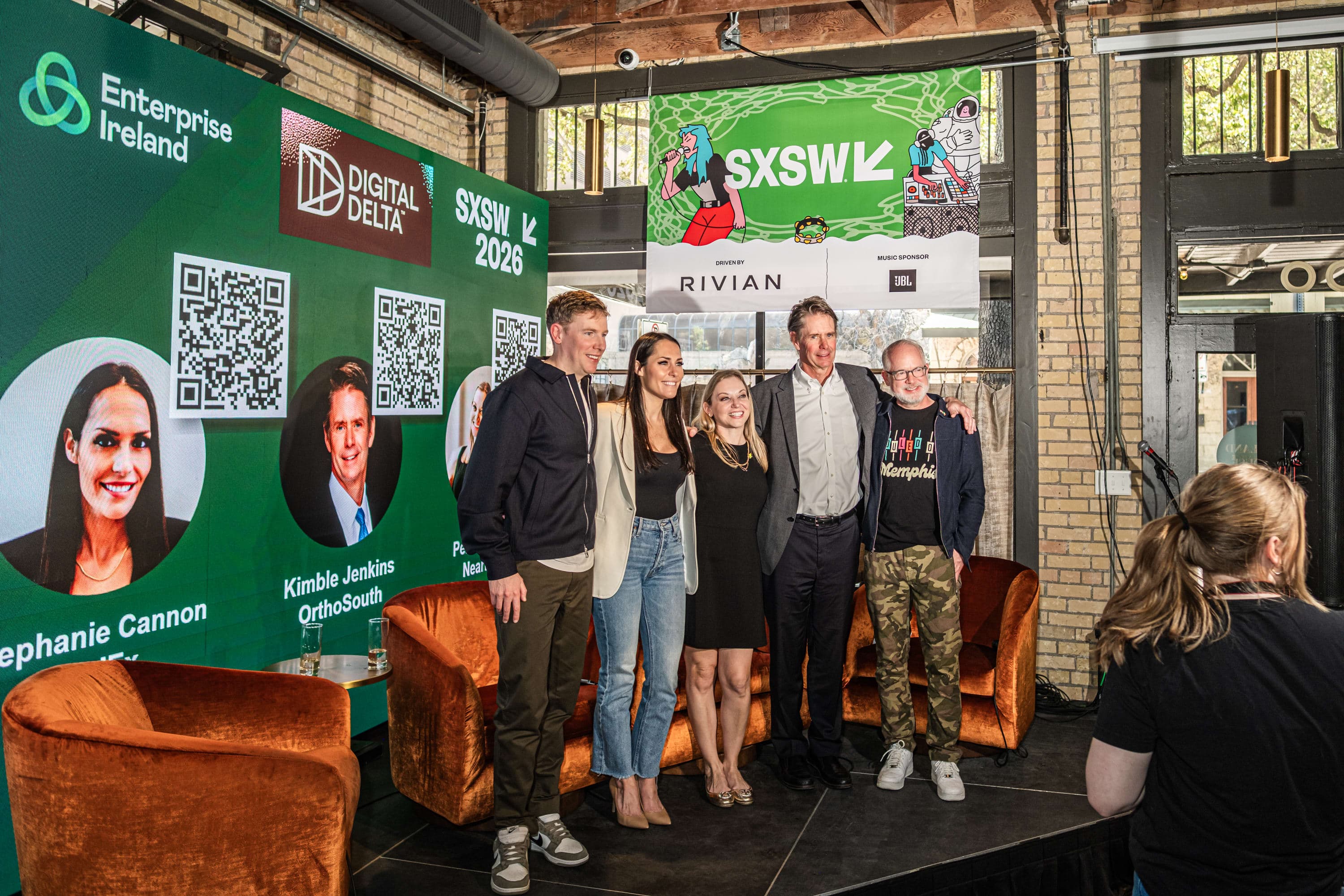
Nearform attended SXSW 2026 with Enterprise Ireland at Ireland House.
*Peri Kadaster, Chief Communications Officer at Nearform, spoke on the ‘From Hype to Hard Problems: Building AI That Actually Scales’ panel discussion, alongside Kimble Jenkins, CEO, Orthosouth; Andrew Conolly, Founder, Wrksense; and Stephanie Cannon, VP, Digital Global IT, FedEx.
Peri also spoke on The Next Innovation podcast recorded live from SXSW, alongside Brenda Jordan, CEO, AskSobi; hosted by journalist Jennifer Strong. The episode explored "Do humans still matter in the evolution of AI?" - you can listen to this episode here.
But wait - there's more.
Nearform publishes real-world learnings on data & AI, engineering, and digital strategy - with more merged in weekly.
Insights
Perspectives on AI in engineering, product development, and strategy, for enterprise executives.
Community
Deep dives and tutorials by engineers, for engineers.
You may also like