
AI hasn’t created an ideas shortage. If anything, it’s created the opposite.
Businesses are surrounded by a huge range of potential AI use cases, with opportunities to improve customer service, accelerate internal processes, support employees, enhance decision-making, reduce operational costs and create new digital products. Vendors are bringing new ideas, internal teams are experimenting, and execs are asking what AI can do for growth, productivity and competitive advantage.
But this has left leaders unclear on which AI opportunities will deliver meaningful value, how they can prove that value quickly, and how they can scale the solutions across the enterprise.
From AI activity to AI maturity
The overwhelming potential for AI opportunity has actually seen many AI efforts start to slow down - not because the ideas themselves are weak, but because the ambition behind each one is, and the tieback to meaningful business value isn’t clear.
The real challenge is often more structured. Enterprises lack a repeatable operating model for deciding where AI will create value, proving that value at speed, and then scaling what works. They may already have experiments running, proof-of-concepts in progress and teams exploring new tools, but - rather importantly - AI activity is not the same as AI maturity.
AI maturity isn’t about how many tools you’ve adopted, or how many pilots you’ve launched. It’s about whether you’ve moved consistently from opportunity to outcome. In simple terms, it sees organisations follow a repeatable journey: idea, proof, scale and repeat.
Each stage requires a different level of discipline. At the idea stage, the challenge is prioritisation. Enterprises often have too many possible use cases, and not enough clarity on which are most closely tied to revenue, cost, risk, customer experience or strategic advantage.
At the ‘proof’ stage, the focus shifts to validation. A proof-of-concept may show something that’s technically possible, but that doesn’t mean it’s valuable, usable or worth scaling.
At the ‘scale’ stage, it’s all about production. AI solutions need to fit into real workflows, integrate with existing systems, meet operational requirements and be adopted by the people and teams they’re designed to support.
Finally, at the ‘repeat’ stage, the challenge is capability. Enterprises need to avoid starting from scratch every time, so the focuses here are patterns, governance, reusable components, delivery discipline and a clearer way to manage a portfolio of AI opportunities.
This is the maturity gap, where we move beyond curiosity and turn AI into a consistent source of business value.
Execution is becoming a differentiator
To try to prove value, enterprises rely on AI pilots as they help explore possibilities, test assumptions and build confidence. But while they are important, they’re also not the finish line.
Too often, pilots aren’t designed with production in mind. They sit outside business processes, measure success in technical terms rather than commercial impact, or lack a shared execution model. This results in promising ideas becoming fragmented efforts with unclear ROI, while the pressure to show faster process remains. And leaders feel the tension - they know AI matters to remain competitive, but they also need to avoid wasted investment and disconnected experimentation.
The answer isn’t to experiment less, but to focus on more purposeful execution. It’s identifying the right opportunities and turning them into measurable business outcomes with speed and discipline. This requires a different way of working. Enterprises need a way to move quickly without things becoming chaotic, and ideas need to be tested without losing sight of production.
Through AI-native engineering, teams can explore, prototype, build and iterate faster than before, creating more room for experimentation. But this approach raises the importance of focus. If organisations can run more experiments, they need a stronger operating model to decide which experiments matter, what outcomes they should target and which solutions they should scale.
This is where an AI factory comes in.
Moving from experimentation to a robust AI operating model
To move from activity to impact at pace, organisations need a repeatable operating model. An AI factory provides this structure, connecting business priorities with delivery, adoption and measurable value. Instead of one-off projects, it creates a consistent path from idea to outcome.
Now, the word ‘factory’ can sound mechanical, so it’s worth being clear about what we mean in this context. It’s not about mass-producing generic AI solutions, but about creating a repeatable way of working that helps enterprises connect AI ambition to business priorities more quickly.
A good AI factory brings together the ingredients that are often fragmented across an organisation: business prioritisation, product thinking, data capability, AI-native engineering delivery, governance, adoption planning and value measurement. It creates a structured path for deciding what opportunity to pursue, how to test them and how to scale them if the value is real.
In a nutshell, an AI factory ensures every initiative starts with the right problem, proves value quickly and is built to scale.
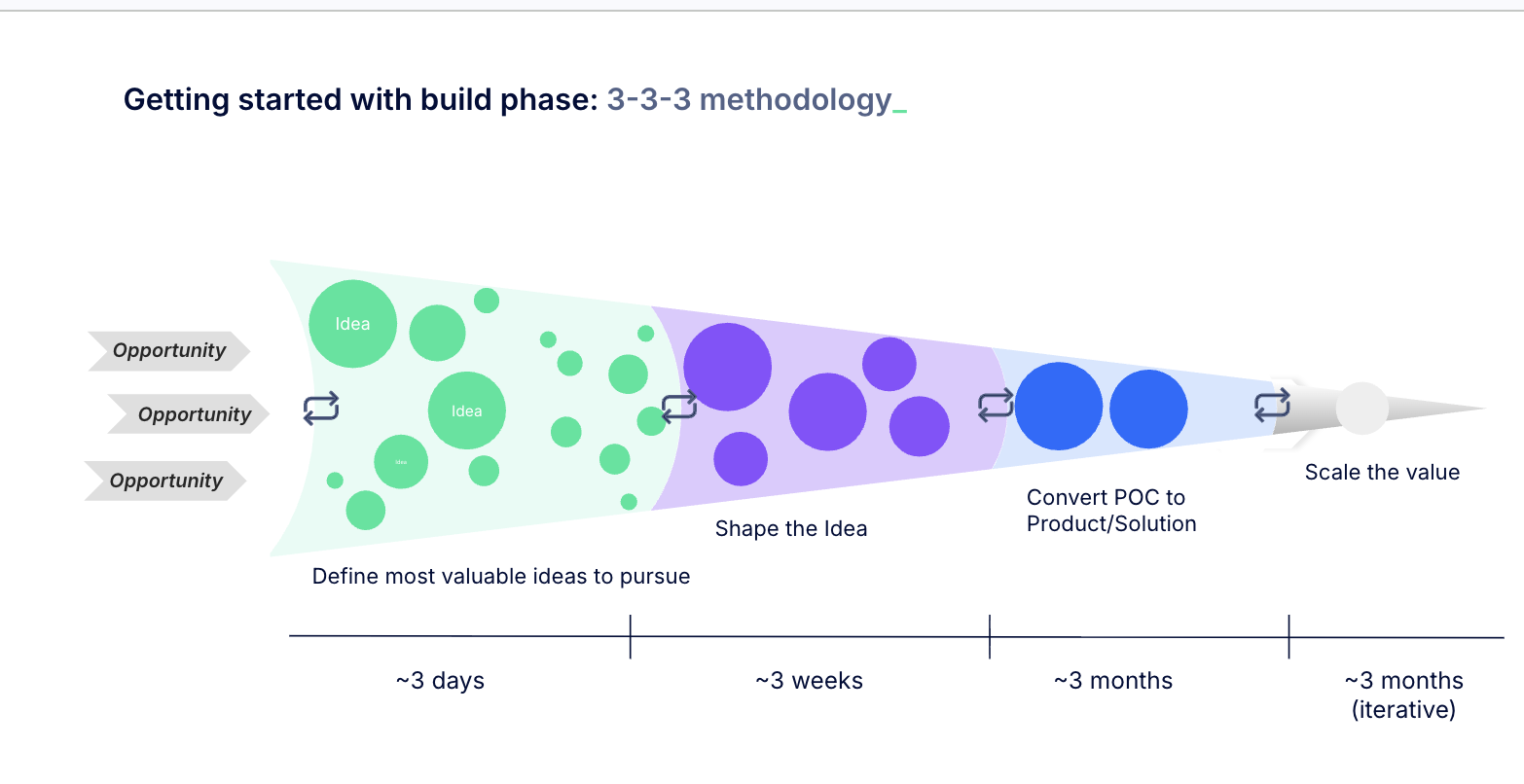
At Nearform, we use the 3-3-3 rhythm to illustrate this: 3 days to prioritise, 3 weeks to prove value, 3 months to launch a first release.
This doesn’t suggest every AI opportunity is identical, or that every organisation follows the same path. The shape of the work using this approach will always depend on the business problem, data environment, technical complexity, operating context and appetite for change. The point of the AI factory rhythm is simply to create momentum, while keeping the work anchored in value.
- The first stage, prioritisation, means asking questions like: which opportunity should be pursued first? Which is tied to a meaningful business outcome? Which has the right combination of value, feasibility, data readiness and organisational sponsorship?
- The second stage, proof , looks at whether the opportunity can be validated quickly and whether the team can test if the solution will create value for users and the business.
- In the third stage, the focus is launch . Can the solution be taken into a real environment, integrated into workflows and measured against the outcome it was designed to improve?
Building confidence through structure
For many leaders, one of the hardest parts about AI transformation is telling a clear and confident story about progress. Leadership teams want to know where investment is going, business units want to understand how AI will help them to achieve their goals, technology leaders want to ensure solutions are robust, scalable and responsible, and teams want clarity on what to work on next.
A factory model helps by creating structure. It gives leaders a way to manage AI as a portfolio of opportunities, rather than a collection of disconnected experiments. It helps teams navigate a common path, from idea to proof to scale. And it makes it easier to see which initiatives are working and which need to change.
As AI-native engineering increases the speed and capacity of delivery, the need for a clear AI operating model becomes even more important. The organisations that win won’t necessarily be those with the largest number of AI pilots, they’ll be the ones that build the maturity to turn the right ideas into value, and then scale that value with confidence.
At Nearform, we work closely with enterprises to get their very own AI factory up and running. Ready to find out more? Contact us.
But wait - there's more.
Nearform publishes real-world learnings on data & AI, engineering, and digital strategy - with more merged in weekly.
Insights
Perspectives on AI in engineering, product development, and strategy, for enterprise executives.
Community
Deep dives and tutorials by engineers, for engineers.
You may also like

A CTO’s guide to spec-driven development (SDD)