New solutions to old bottlenecks: Nearform recaps AI Native DevCon London 2026 (Part 2)
Nearform was the headline sponsor of AI Native DevCon London 2026. Here’s where we think the industry goes next. (Part 2)
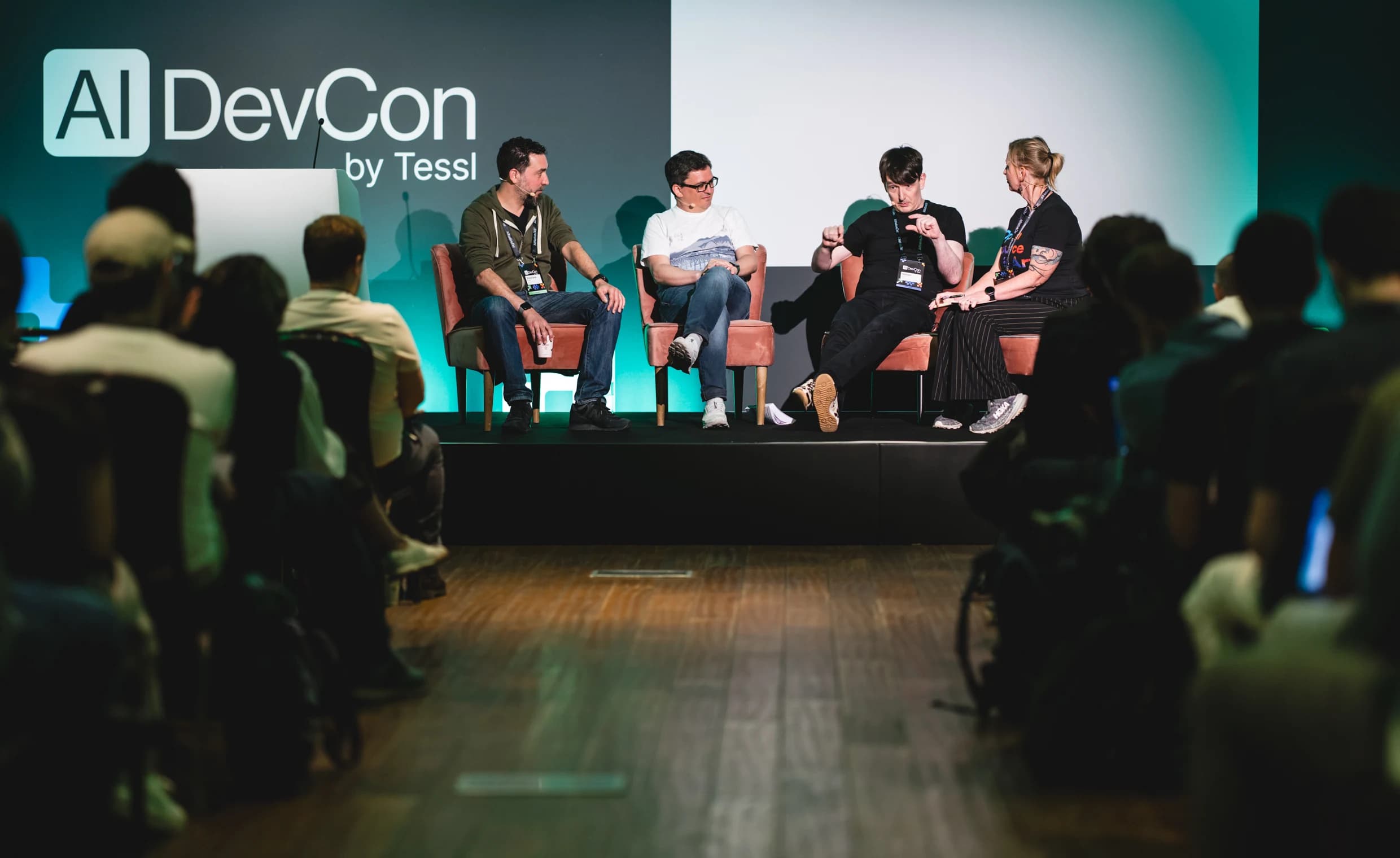

(This is Part 2 of a 2-part article - link to Part 1 here)
Over the course of two days, we heard luminaries from Anthropic, OpenAI, Meta, Tessl, Nearform and more take the stage to discuss key themes, including hardness engineering and skills as the new code. We determined that org charts are the new architecture diagram, and that trust and security is more important than ever before - but requires a new approach.
Keeping AI honest
A healthy scepticism ran through the verification track - and it will sound familiar to readers of our own take on the war on vibe coding. Continuous delivery pioneer, Dave Farley, led the charge, arguing that natural language lacks the formal grammar, unambiguous intent and deterministic execution that programming demands. His answer isn’t less AI - it’s executable, BDD-style specifications, with AI treated like a compiler: “We’re not going to care for very much longer about the code that it generates, because we’ll verify that we’ve got the results.”
- Neaform’s Steve Goode and Alfonso Graziano ran a practical workshop on how to transition from Prompting to Production-Ready Systems through Spec Driven development. The throughline: “use AI tools as executors of specs, not substitutes for thinking”, plus practical techniques for keeping code, spec and intent synchronised to prevent drift over time.
- Simon Martinelli - Lessons from Spec-driven Development: system use cases (Jacobson, 1987!) as the stable spec unit, and the insight that architecture style determines whether AI codegen is tractable - self-contained vertical systems give agents the right context window, microservices fragment it. If you’re weighing up this approach, our CTO’s guide to spec-driven development covers how we apply it in practice.
- Simon Obstbaum & Rob Willoughby — Why Evals Are Hard: output evals miss the journey, trajectory evals tell you whether the agent followed the path you intended. (For additional reading: we covered the topic of evals and how to craft them in From AI prototype to production: how to build evals for reliable agents)
Looking ahead to what’s next
Experts across a variety of functions offered their hypotheses, or best guesses at least, on what developers should be prepared to tackle over the rest of the year, including:
- Luke Marsden - Giving Every Agent Its Own Desktop: “give each agent their own computer, not each human” - and a platform that builds itself.
- May Walter - From Blind Spots to Merged PRs: automate the investigation, not just the fix - runtime intelligence that surfaces high-ROI performance wins. And a line that stuck with us: “If it works 90% of the time, it’s not an automation - it’s streamlining humans.”
And in the most human moment of the conference, McKinsey & Company’s Dave Kerr's deeply personal talk on bipolar disorder, dysregulation and AI reminded a room full of engineers that the most important system we operate is ourselves.
Don’t just read about the talks - interrogate them
Fittingly for an AI-native conference, the organisers did something we’ve not seen before: every talk has been distilled into a skill on the Tessl registry - ainativedev/aidevcon-2026-ldn .
Install the bundle, and your coding agent can answer questions about any session, apply a speaker’s framework to your own codebase, or audit your team against (for example) Katie Roberts' brownfield guardrails.
The conference content itself is now agent-ready context - the event practising what its own keynote preached.
Where this leaves us
The bottleneck has moved. Code generation is solved enough. Specification, verification, review and organisational design are where the gains are won or lost. That’s precisely the work of AI-native engineering. If you’re working out what AI-native delivery looks like for your organisation — brownfield or greenfield — talk to us.
Catch every session on the AI Native DevCon London 2026 YouTube playlist, and explore the talks interactively via the Tessl skills registry.
You may also like
New solutions to old bottlenecks: Nearform recaps AI Native DevCon London 2026 (Part 1)
Insight, imagination and expertly engineered solutions to accelerate and sustain progress.