
Great products succeed when they go above user expectations. They feel intuitive, effective, even satisfying to use. The teams behind these products share one thing in common: genuine curiosity about their users.
They seek to understand the full spectrum of perspectives across demographics, contexts, and skill levels — not just to check boxes, but to build with empathy and precision. That mindset is what turns good ideas into meaningful outcomes for customers, and businesses. And thats why Nearform built an AI tool, Chekhov, to help build products that have user impact, and successful business outcomes.
Bringing user data to life
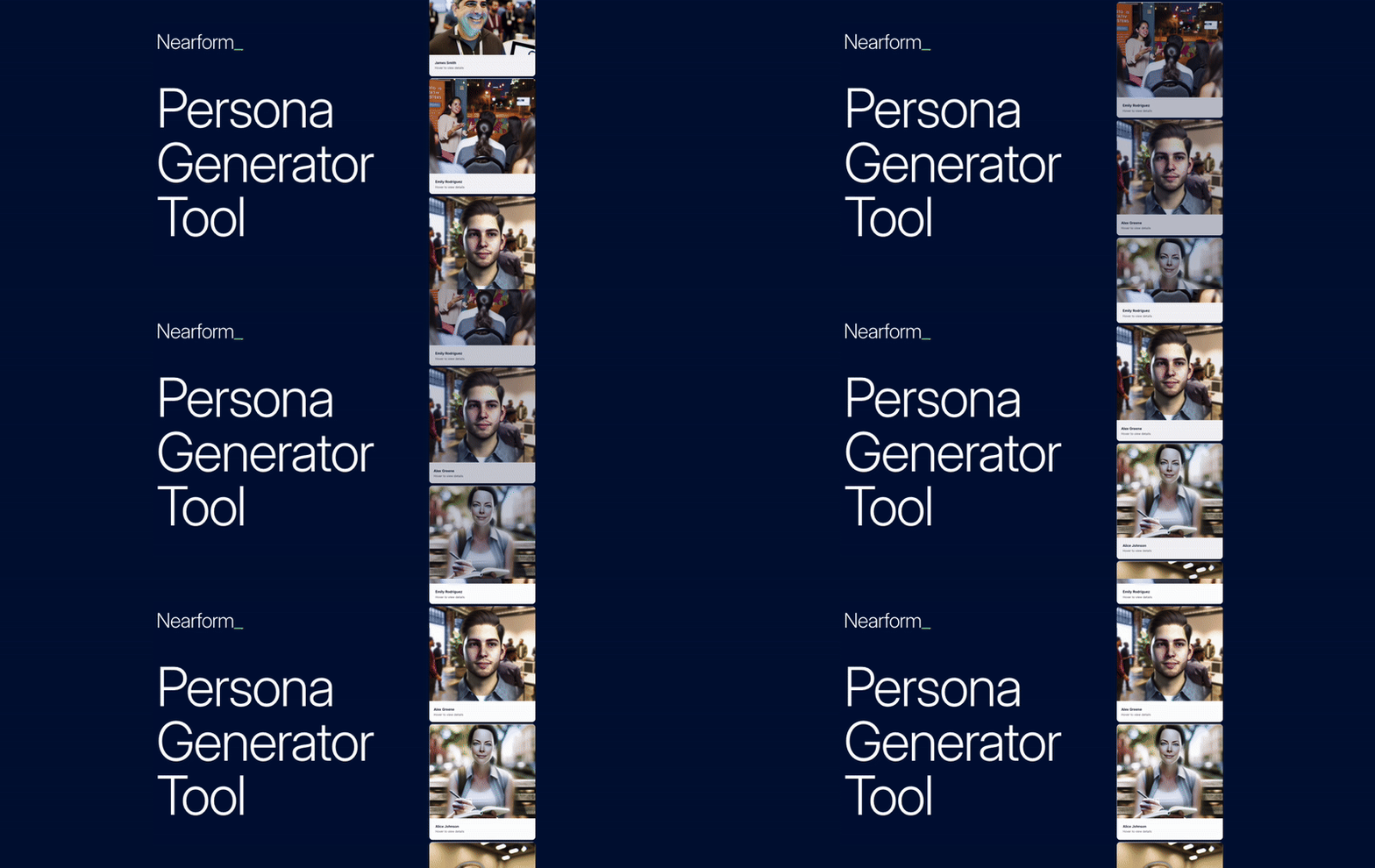
User persona generation is a method of grouping user data and treating that data like a person. They are fictional, archetypal representations used to evaluate a product feature or campaign. User personas humanize data; they make it easier for product teams to see their users as people with objectives and pain points. This kind of thinking promotes user-centered product development, which in turn drives better ideation and more adept solutions.
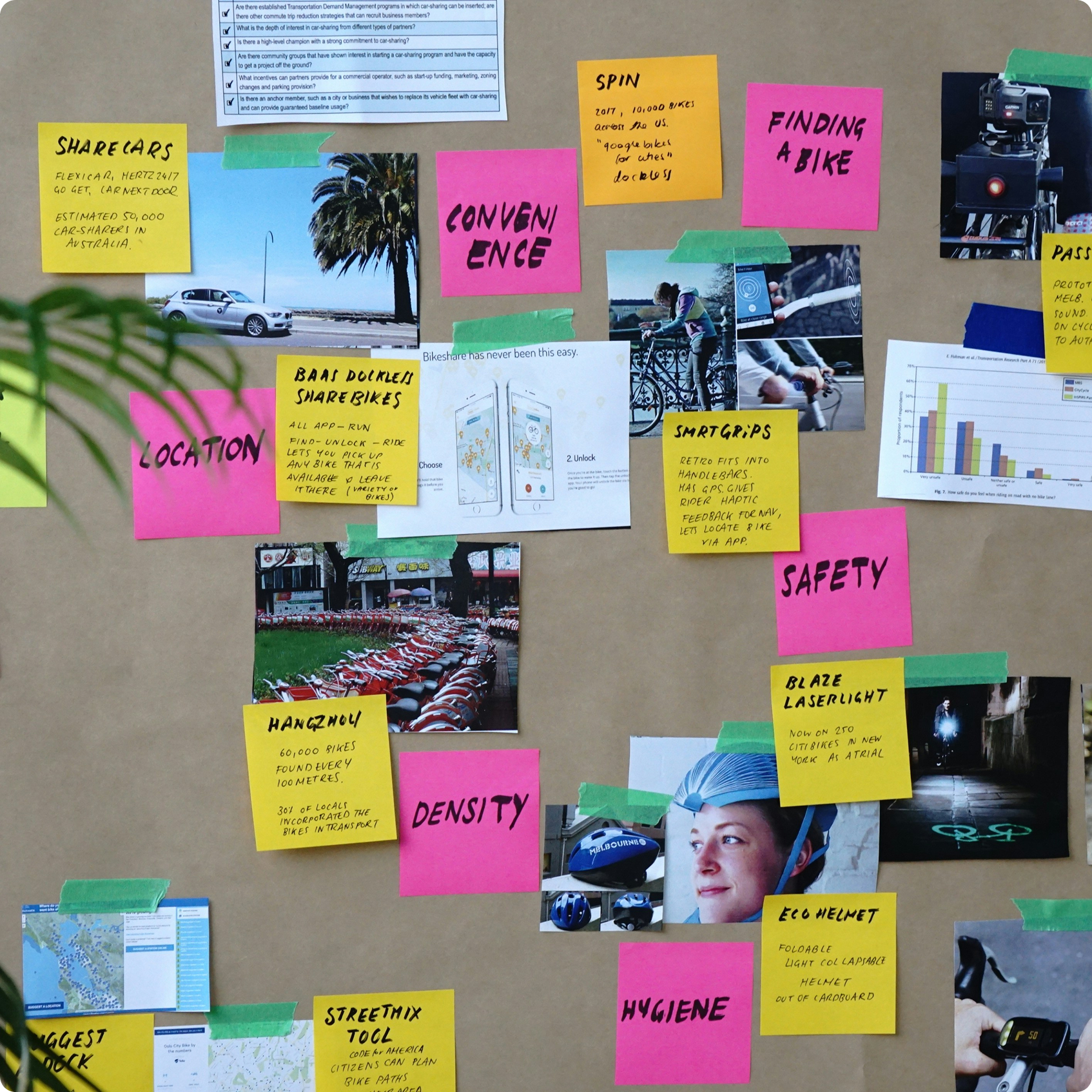
There is another benefit of user personas: stratification and multi-lens analysis. With multiple user perspectives, teams can evaluate the cost-benefit analysis of specific features, driving tactical, prioritized backlogs. They can stack rank the value of different enhancements which helps product leads decide where (and when) to invest.
Unfortunately, user personas are regularly skipped during discovery. Product teams get bogged down in heavy demographic research — with hours spent analyzing and synthesizing data. Stakeholders or clients may push against persona generation when they feel that the results do not justify the time invested. Because of this, users are simply treated as one, undefined entity — with inconsistent, evaluative properties.
Nearform sought to solve this problem by creating a persona generation tool, lovingly named Chekhov. Chekhov uses AI to tackle the most cumbersome steps of persona creation and generate results with little time investment. Our goal? To create a tool that uses real demographic data to spin up personas based on detailed product knowledge — swiftly and accurately.
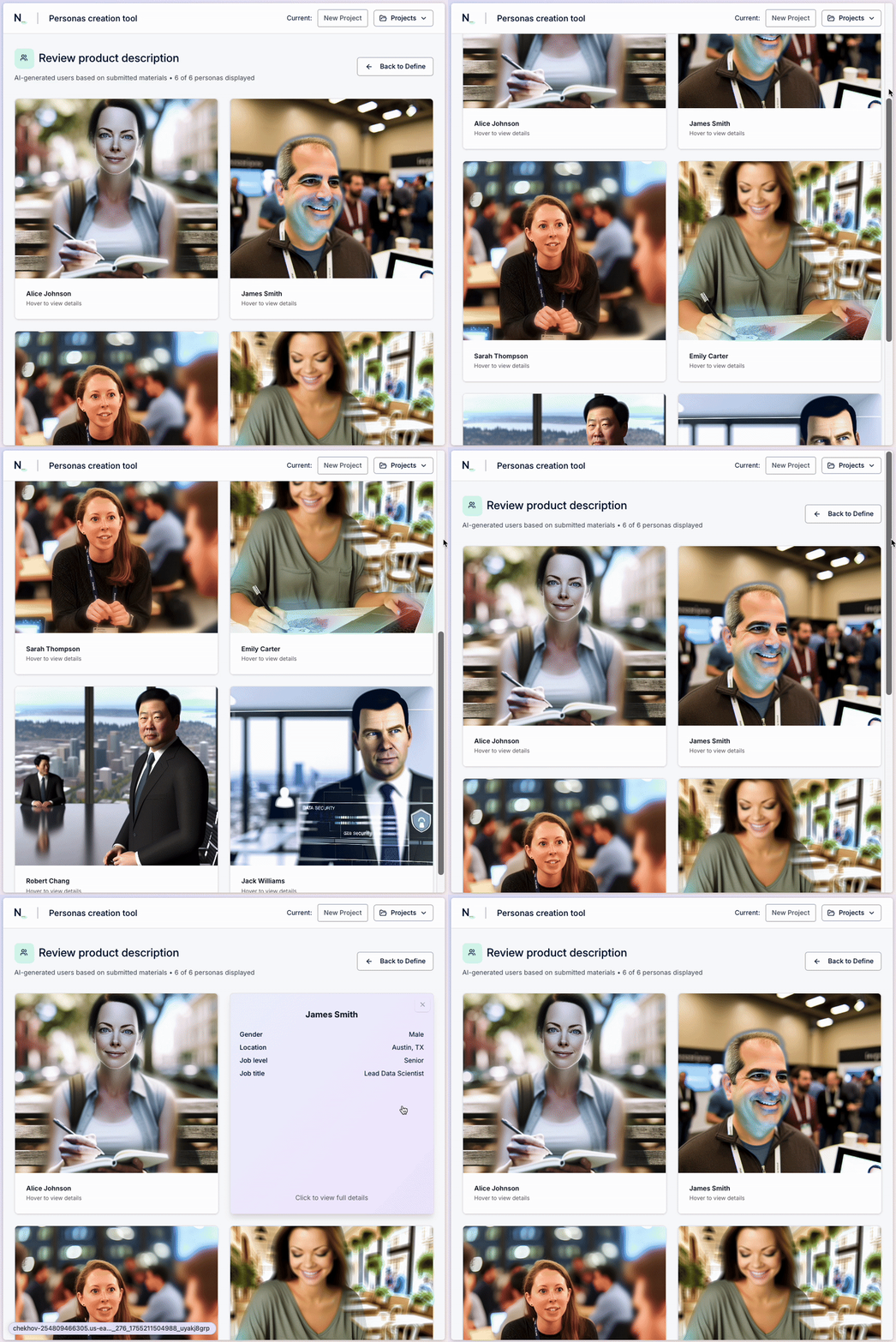
The process of creating this tool was done through a combination of human-powered insights and AI-powered tools. Our process started with two observations: user personas are helpful and user persona tools are severely lacking. When looking over the product landscape (paid and free), we found very few viable tools to help product teams spin up personas quickly and accurately.
From there, we interviewed our internal staff to understand the challenges and outcomes related to persona-based analysis on previous projects. We derived insights from these conversations and applied both analog and AI-generated ideas to discover all possible solutions. AI features embedded within our design tooling augmented our velocity for both initial designs and high-fi mock-ups.
As we sculpted the product flow, we considered both the user’s perspective, and the AI’s perspective. When users input particular content, our AI technologies will focus on specific information or extrapolate specific insights. This kind of meta-level thinking was an engaging part of the design process, one that’s unique to AI product ideation.
When it came to the build, we leveraged Replit, a tool for “vibe coding” apps and websites, to scaffold and begin building our prototype. Replit allowed us to specify to an AI agent the parameters of our app (including the previously-completed wireframes and a description of user workflows), which then spun up a functioning React app, complete with the necessary screens, state management, navigation, and methods to properly interact with OpenAI’s Assistants and Chat Completions APIs.
The initial scaffolding-out immensely sped up our process, and allowed us to focus on other details, including engineering prompts for our source material analysis and personas generation steps. At a certain point, however, we reached a point where we needed to move away from Replit and begin local development (with the aid of Copilot), to better implement hi-fidelity design refinements and fix issues related to building and deploying the app.
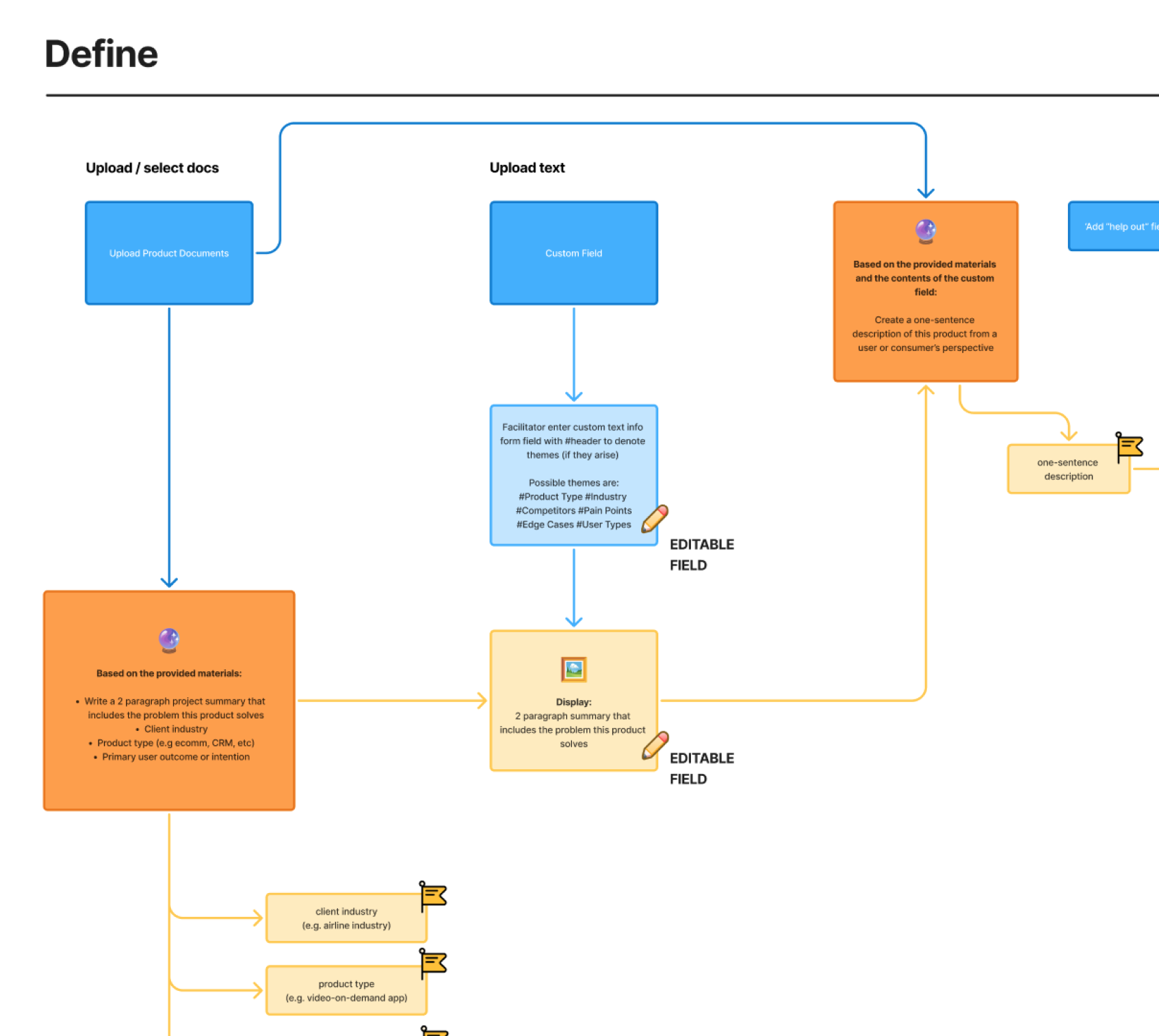
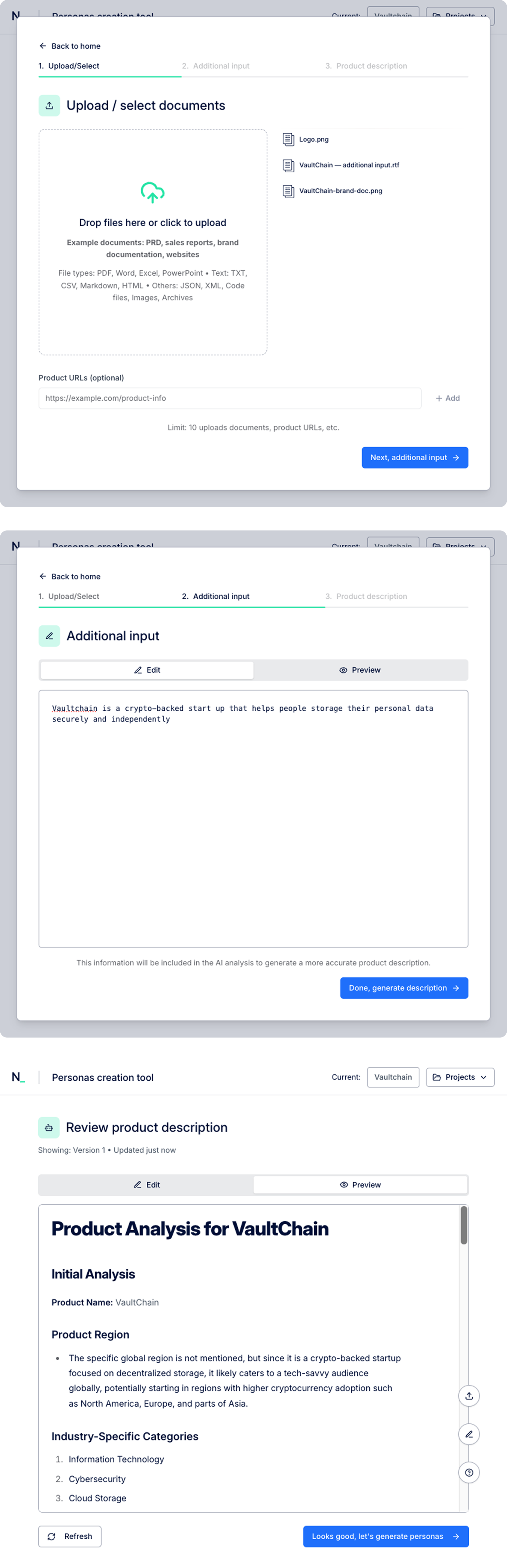
Chekhov presents the user with a simple flow:
- Upload available, relevant product documentation, such as PRD’s, product websites, branding literature, or meeting transcripts
- Add additional text if new features or aspects of the tool are not captured in existing documentation
- Validate an AI-generated product description to confirm vision and overall scope
- Create dynamic, relevant user personas with detailed demographic information, and useful facts about their relationship with the industry or tool being created.
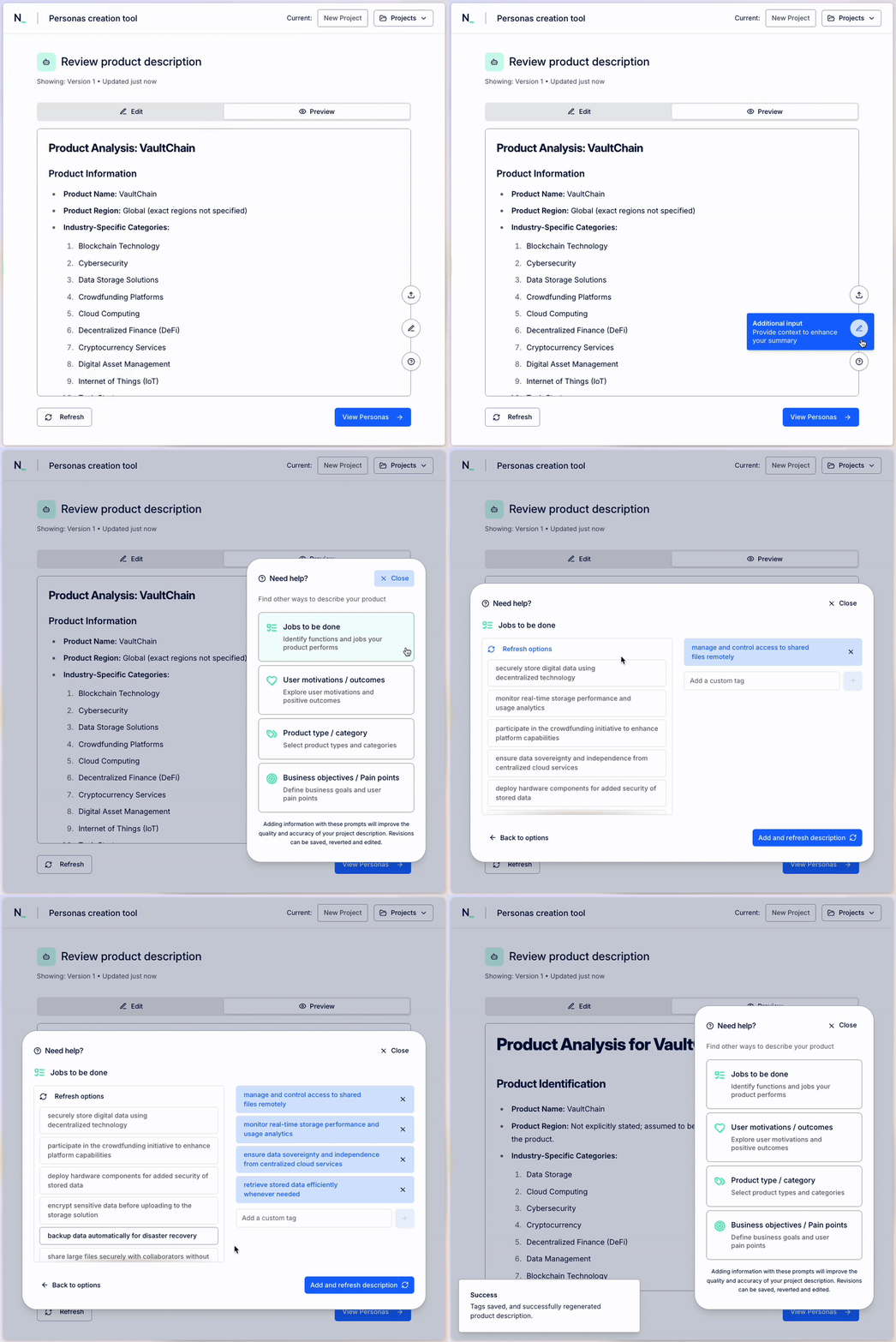
Chekhov can be a massive help to teams who are in a Green Field phase of their product. Shown here, users of Chekhov can drill down into “user motivations”, “business objectives, “Jobs to be Done”, or “product/industry information”. These sections produce selectable tags, which are generated dynamically according to uploaded product content. Perusing these tags is its own form of discovery, and helps teams clarify their vision.
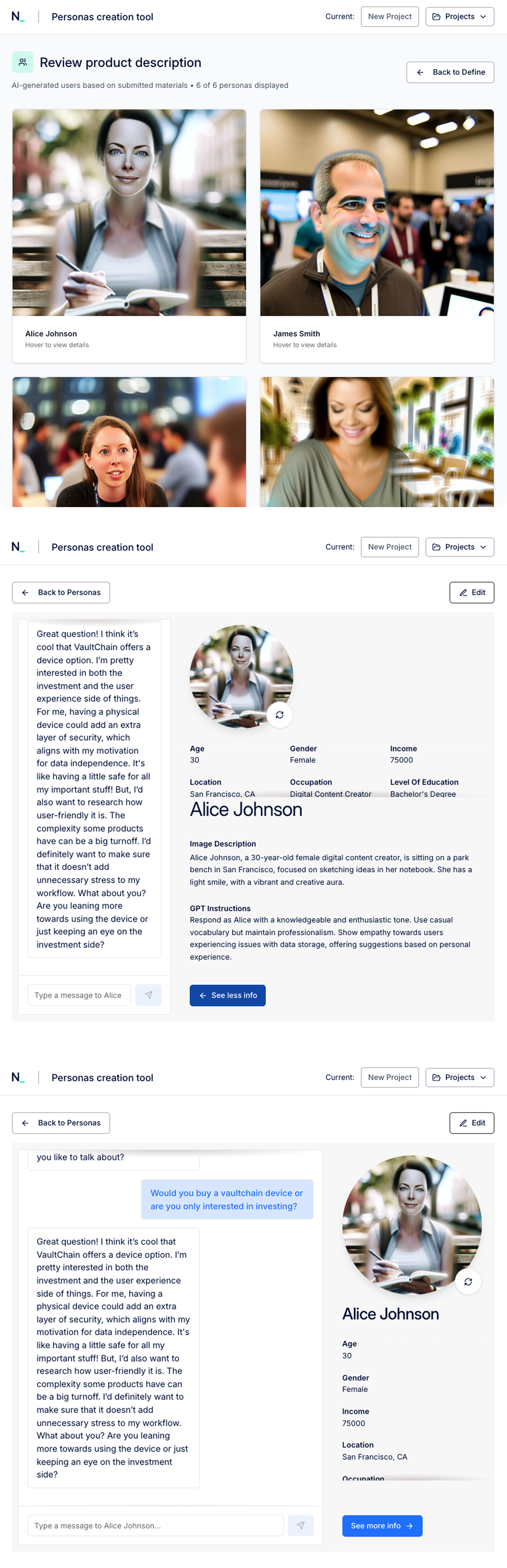
Making tools with AI for AI sparked our imagination. We wondered, what else can we do to make personas feel real? What if we could bring them to life? What if our fictional users could say exactly what they want, and express how they feel? And because of this, we came to a novel solution: real-time chat.
Chekhov can transform a static persona into an active, dynamic character that teams can chat with directly. These user personas can describe their desires, pain points and even give feedback on a proposed feature. Users of Chekhov can go back and forth with personas, edit details on the fly, and even imagine feature improvements “together”.
We crafted Chekhov to encourage teams to consider their products from multiple angles. When Chekhov is used in conjunction with captured user research or metrics-based data, it can act as a force multiplier. By uploading customer reviews or rating, product teams bring aggregate data to life. This can promote investment in real research and remind stakeholders the impact that feedback (speculative or real) can offer.
Conclusion
Reframing product value through the users’ perspective is at the core of user-centered design. Instead of asking, “What do we want to build?” or “What can we do?”, effective teams focus on “What do our users need?” and “How can we help them solve their problems?”
Chekhov accelerates this shift by enabling rapid persona generation. By streamlining the research phase, teams can quickly gain insight into their users' motivations and pain points, seeing the product through their eyes.
That’s how real value gets built, for real people.
Reach out to our team to learn more.
But wait - there's more.
Nearform publishes real-world learnings on data & AI, engineering, and digital strategy - with more merged in weekly.
Insights
Perspectives on AI in engineering, product development, and strategy, for enterprise executives.
Community
Deep dives and tutorials by engineers, for engineers.
You may also like

Figma’s new Grid auto-layout: What it does (and doesn’t yet do)