
The AI landscape is evolving at an unprecedented rate, in particular with advancements in large language models (LLM) capabilities. Business leaders face a pivotal decision: should they build their enterprise AI strategy on open-weights or closed-weights large language models? For VPs or CTOs tasked with harnessing AI, this choice carries significant implications for innovation velocity, cost structure and strategic flexibility.
Open-weights models, where some or all neural network parameters are accessible and modifiable, represent a fundamental shift from the black-box approach of closed models. While closed models from major providers offer convenience through API access, they limit customisation options and create potential vendor lock-in.
In contrast, open-weights models empower organisations to fine-tune for specific use cases, integrate proprietary data securely and maintain full control over their AI assets. These considerations are increasingly critical as AI becomes embedded in core business functions.
In this post, we’ll delve deeper into the differences between open source, open-weights and closed-weights models to understand what is the right choice for your use case.
Different types of models
Open source large language models represent a significant paradigm in AI development, where the code, model weights and the training dataset are freely available to the public. These models, such as Bloom, Falcon or the recent OLMo 2 32B, allow researchers and developers complete visibility into their architecture and training methodology.
The transparency inherent in open source models facilitates collaborative improvement, as communities can identify issues, suggest optimisations, and contribute to the model's evolution. This democratisation of AI technology enables wider experimentation and innovation, particularly benefiting smaller organisations and academic institutions that might lack resources for developing proprietary models.
However, this openness comes with challenges: Open source models may struggle to compete with well-funded closed models in performance benchmarks, and their accessibility raises questions about potential misuse for generating harmful content without proper safety mechanisms.
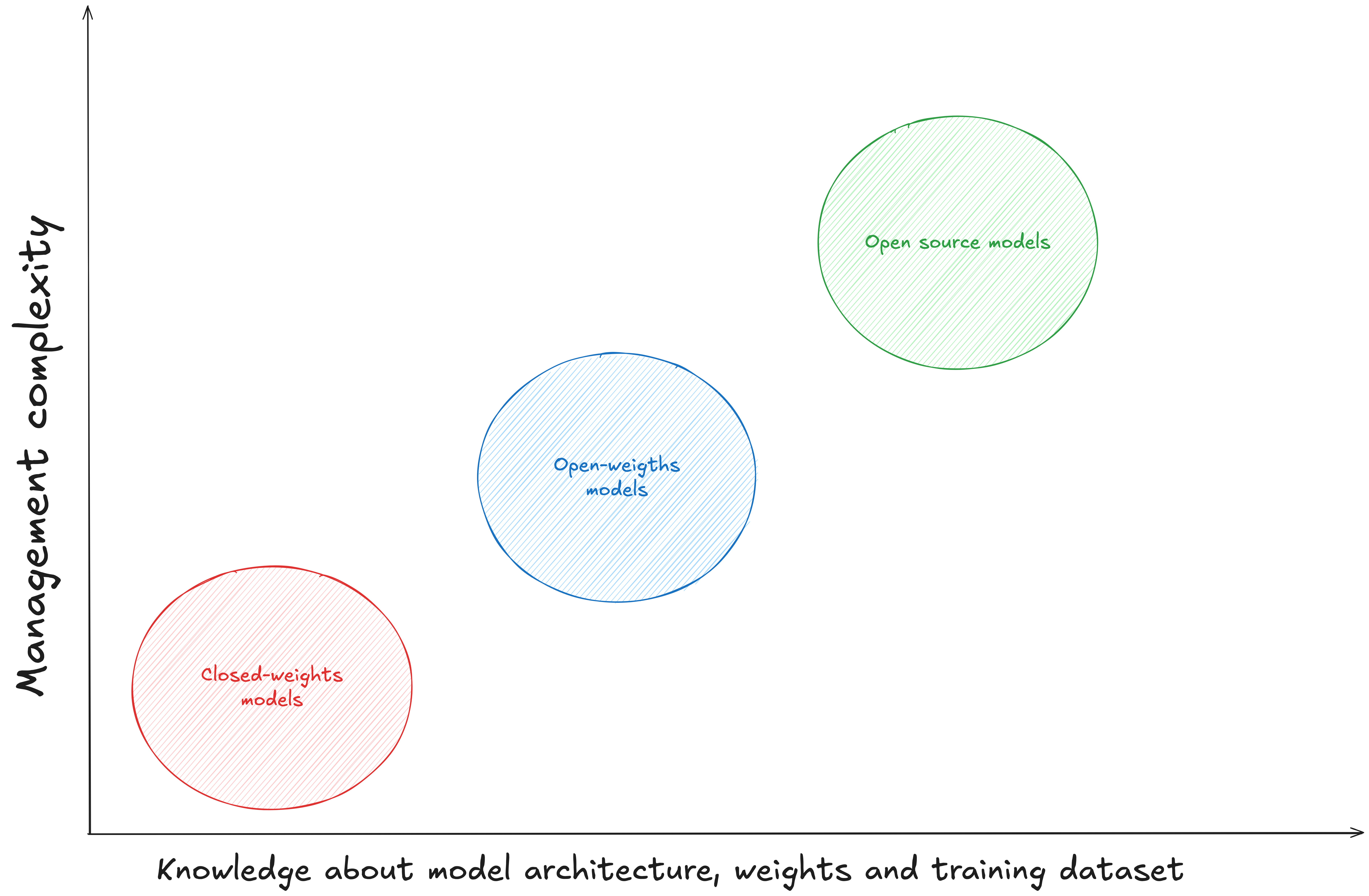
Open-weights large language models occupy a middle ground in the AI landscape, where the model weights (the numerical parameters that define what the model has learned) are publicly available, but the code or training methodology might remain proprietary. Models like llama from Meta, DeepSeek, and some versions of Mistral (Mixtral 8x7B) fall into this category.
This approach allows developers to download and use pre-trained models for inference or fine-tuning while the original creators maintain some control over implementation details.
The availability of weights enables researchers to analyse the model's behaviour and perform valuable studies on bias, robustness and other characteristics without understanding how the model was created.
Open-Weights models facilitate transfer learning and specialised applications, as developers can build upon existing knowledge encoded in the weights. However, without complete transparency into training methods, it can be challenging to fully understand or address fundamental limitations in these models.
Closed-weights large language models represent the most restrictive category, where both the code and weights remain proprietary and inaccessible to the public. Models like GPT-4, Claude, and PaLM exemplify this approach, where interaction is typically limited to API access.
These models are often developed by well-resourced organisations that invest heavily in research, computing infrastructure, and vast training datasets.
The closed nature allows companies to protect their intellectual property and competitive advantages while maintaining tight control over model deployment and safety measures. This approach enables more consistent user experiences and potentially more robust safety protocols, as the developers can monitor and update models centrally.
However, the lack of transparency raises concerns about bias, fairness and accountability, as external researchers cannot independently verify claims about the model's capabilities or limitations. Additionally, the concentration of powerful AI technology within a few organisations raises important questions about the equitable distribution of AI benefits across society.
The following table summarises the main features of the three types of models:
| Aspect | Open Source LLMs | Open-weights LLMs | Closed-weights LLMs |
|---|---|---|---|
| Transparency | Full (code, weights and training data available) | Partial (only weights available) | Limited (proprietary code and weights) |
| Examples | Bloom, Falcon | Llama (Meta), DeepSeek, Mixtral 8x7B | GPT-4, Claude, PaLM |
| Benefits | • Collaborative improvement • Community contributions • Democratised access • Supports academic/smaller organisations | • Allows analysis of behaviour • Enables transfer learning • Supports specialised applications • Can study bias and robustness | • Protected intellectual property • Controlled deployment • Consistent user experience • Centralised safety protocols |
| Challenges | • May underperform vs. well-funded models • Potential misuse without safety measures | • Limited understanding of training methods • Difficult to address fundamental limitations | • Concerns about bias/fairness • Limited independent verification • Equity questions about AI benefits • Concentrated power |
| Control | Community-driven | Mixed (creators maintain some control) | Company-controlled |
The power and flexibility of open-weights models in AI
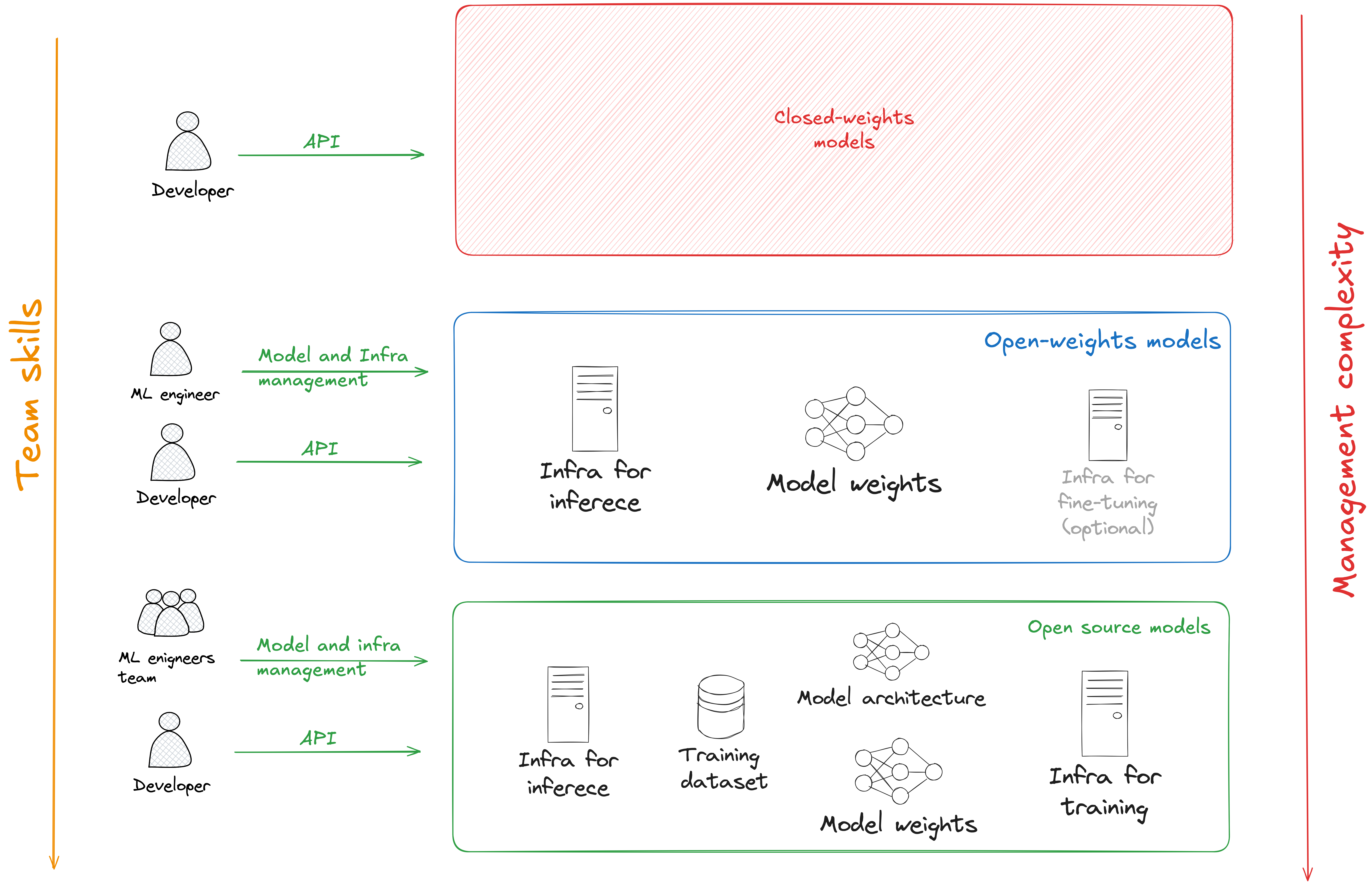
Open-weights models represent a good trade-off between management complexity and knowledge about the model. These kinds of models allow you to deploy the technology on your own infrastructure, giving you complete control over your AI implementation.
This autonomy means you're not subject to sudden pricing changes, usage restrictions, or service interruptions that can happen with API-based models. You can customise hardware configurations to optimise for your specific performance needs, whether that's maximising throughput, minimising latency, or balancing cost efficiency.
This level of flexibility is transformative for organisations that require reliability and consistency in their AI systems, especially those operating in regulated industries where data sovereignty and privacy considerations are paramount. The ability to maintain your models behind your own security perimeter eliminates many of the compliance concerns associated with sending sensitive data to external APIs.
Open-weights models offer a transformative approach to AI by enabling organisations to create deeply customised solutions through fine-tuning, though this process comes with significant computational costs. Deploying these models requires specialised hardware like high-end GPUs or TPUs and technical expertise to effectively train and optimise, necessitating a careful calculation of the total cost of ownership.
Companies like Groq exemplify this shift by offering specialised infrastructure optimised for specific open-weights models, allowing organisations to choose the hosting solution that best meets their performance, cost, and scaling requirements. This approach prevents lock-in, drives innovation in deployment methods and gives organisations the freedom to switch providers without needing to retrain their systems or modify their applications.
Organisations must carefully review the licensing terms of open-weights models before implementation — many models come with licensing restrictions that significantly impact how businesses can deploy them.
An example is Meta's Llama models. They technically fall into the open-weights category, but operate under a unique licensing framework that creates important distinctions in how they can be used. Unlike other open-weights models, Llama's license includes specific restrictions that prevent certain organisations (particularly those developing competing AI products) from utilising these weights commercially.
Despite these investments, many organisations find the benefits compelling: Improved domain-specific accuracy, reduced reliance on extensive prompting and the ability to encode proprietary knowledge directly into the model.
The most powerful advantage lies in the potential for truly private AI solutions that can be seamlessly integrated within an organisation's infrastructure. This allows industries like healthcare, finance and government to develop AI systems that understand specialised terminology and complex regulations while maintaining strict data confidentiality.
By fine-tuning models on proprietary data and deploying them within their own networks, organisations can create AI assistants that go far beyond generic API-based solutions. They achieve a level of customisation and privacy that represents the next frontier of enterprise AI adoption.
The reality of closed-weights models in AI
Closed-Weights models offer a remarkably straightforward approach to implementing AI capabilities in your organisation.
These models are typically accessible through simple API calls that can be integrated into your applications with minimal development effort. This plug-and-play nature eliminates the need for specialised machine learning (ML) infrastructure, high-performance computing resources or a team of ML engineers to keep everything running smoothly.
For many businesses, especially those without substantial technical resources, this represents an ideal entry point into advanced AI. You can focus on building valuable applications rather than managing complex infrastructure. The providers of these models handle all the underlying complexity — from model hosting and scaling to security patches and performance optimisations. This division of labor allows your organisation to benefit from cutting-edge AI capabilities while maintaining focus on your core business objectives and domain expertise.
When using closed-weights models through APIs, you face a significant uncertainty regarding how your data interactions might be used by the model provider. Most providers maintain policies that allow them to collect and potentially utilise the queries and content you submit to improve their models through future training iterations. This creates a complex privacy consideration, especially when working with sensitive, proprietary, or regulated information.
While providers typically offer options to opt out of data collection, the default settings often favour data retention. This raises important questions: Could your unique industry insights, product descriptions or customer service scenarios eventually become incorporated into models that your competitors might use? Could confidential information submitted to these systems eventually manifest in responses to unrelated queries?
The lack of transparency into exactly how submitted data is processed, anonymised, stored and utilised creates a trust requirement that organisations must carefully evaluate, particularly when working with information that provides a competitive advantage or falls under strict regulatory oversight.
Building business processes around closed-weights models accessed via APIs introduces a significant element of economic uncertainty into your technology strategy. Unlike fixed-cost infrastructure investments, API pricing models are subject to change at the provider's discretion — sometimes with limited notice. We've already witnessed several major AI providers substantially revising their pricing structures as they better understand their own costs and the market's willingness to pay. These adjustments can impact the financial viability of AI-powered applications built on these services.
Beyond direct pricing changes, providers may alter their service tiers, token limits or feature availability in ways that necessitate architectural changes to your applications. This dependency creates business continuity risks that are difficult to mitigate.
If prices increase beyond your budget constraints or if service levels change in ways incompatible with your needs, transitioning to alternative providers can involve significant technical debt and reengineering efforts. Organisations building critical business functions on these APIs must carefully consider this lack of pricing predictability and control when evaluating their long-term AI strategy.
The reality of true open source models in AI
True open source models, where both code and weights are completely accessible and modifiable, represent an impressive achievement in AI transparency, but may exceed the practical requirements of most organisations implementing AI solutions.
For companies focused on delivering products or services enhanced by AI capabilities, the ability to inspect and modify the foundational architecture of models often provides minimal additional value compared to open-weights alternatives.
The technical overhead of managing, understanding and potentially contributing to the full codebase introduces complexity that rarely translates to business advantage. Most enterprise applications benefit from treating models as reliable components rather than development projects in themselves.
The engineering resources required to meaningfully engage with truly open source models at the code level could typically be better allocated toward domain-specific customisation, integration work or developing the surrounding applications that deliver actual business value.
For many practical implementations, the difference between Open-Weights and fully open source becomes negligible when weighed against organisational objectives.
True open source models create an invaluable ecosystem for research institutions and universities. In these settings, complete transparency into both code and weights enables the deep scientific inquiry necessary for advancing our understanding of machine learning systems.
Academic researchers can investigate fundamental questions about model behaviour, interrogate biases, experiment with architectural modifications and explore novel training approaches, all critical activities that drive the field forward.
This academic and community engagement with open source models creates positive feedback loops, where improvements and insights from diverse research teams contribute to the collective knowledge base. It allows these models to evolve so much that they can now compete with popular commercial closed weights models, like OLMo 2 32B — the first fully open model to outperform GPT-3.5 and GPT-4o mini in some of the multi-skill academic benchmarks.
Conclusion
The distinction between open-weights models and truly open source models illuminates an important reality in AI adoption: Organisations must carefully align their technical choices with their specific objectives and capabilities.
Commercial entities typically benefit from open-weights models due to their flexibility, allowing for fine-tuning to specific needs or direct use in RAG applications without managing complex code and architecture. Meanwhile, research institutions leverage fully open source models for their complete transparency, which advances scientific understanding.
Partners can bring valuable perspective to help organisations select the optimal approach, whether that's leveraging open-weights models for enterprise integration, pursuing fully open source solutions for maximum customisation, or creating hybrid architectures that balance control with implementation speed.
Don't navigate the complex world of AI model selection alone. Whether you need the flexibility of open-weights models for enterprise applications or the transparency of fully open source solutions for research initiatives, the right architectural decisions are critical to your success. Contact Nearform to help choose the best approach for your organisation.
But wait - there's more.
Nearform publishes real-world learnings on data & AI, engineering, and digital strategy - with more merged in weekly.
Insights
Perspectives on AI in engineering, product development, and strategy, for enterprise executives.
Community
Deep dives and tutorials by engineers, for engineers.
You may also like