
Confusion has long surrounded how and when to catch bugs, address security risks, or meet compliance standards in the software development life cycle. Developers, testers and product teams alike have asked: "Why are we finding issues so late?” “Can we prevent delays and rework?” and “How do we build quality from day one?”
This article unpacks how the “shift left” approach answers these questions.
What is shift left?
Shift left is a software development and testing approach that emphasises moving tasks (like testing, security and performance checks) earlier (left) in the software development life cycle instead of waiting until later stages.
Having worked as a quality assurance (QA) engineer for many years, I’ve had to deal with issues like finding bugs too late, not having enough time to test properly, unstable builds, poor communication with developers, inconsistent testing environments and relying too much on manual testing. All of this leads to delays, missed bugs and lower software quality.
Shift left is all about catching these problems earlier instead of waiting until the last minute. Whether it's testing, security or performance checks, the idea is to move these tasks earlier in the development process. This helps teams find and fix issues sooner, making development faster, safer and less stressful.
The implementation of shift left differs across roles, as you can see below:
| Role | Implementation of shift left |
|---|---|
| Developers | Write tests alongside code (unit, integration) rather than waiting for the QA to catch bugs later. |
| Quality assurance | QA is shifting from manual and late-stage testing to early automation in the development cycle. Test cases are created alongside development and CI/CD tests run automatically. |
| DevOps | Automate infrastructure testing and performance monitoring early, preventing surprises in production. |
| Product owners | Feedback gathering happens early in prototyping which will avoid costly redesigns later. |
Why use shift left? A lesson from my own journey of adopting it
I still remember the frustration of catching a critical bug just before release. My team had spent weeks developing a new feature, then, at the last minute, it landed on my desk with an urgent request to approve it. But I found a bug, a big one, and all I could think was: "This could have been prevented, if only we had tested earlier."
This wasn’t a one-off incident. Time and time again, we found issues too late in the cycle, leading to delays in the release and frustrated clients wondering why we couldn’t deliver on time. Each time it happened, I couldn’t help but think, there has to be a better way. That’s when I started looking into shift left as a real solution.
Here are five key advantages of using shift left:
1. Early bug detection = lower fixing cost
If a bug is caught during the design or coding phase, a simple code change can fix it. And when it’s caught early enough, the developer is still in the flow, deep into that part of the code — there’s no need to waste time context-switching or trying to remember where they left off. It makes fixing the issue faster and so much easier.
If it’s found after deployment, it might require hot-fixes, rollbacks and customer support efforts — all of which are costly and time-consuming. For example, instead of finding a login issue in production (where it could impact thousands of users), shift left helps developers catch it with automated tests before the feature is even released.
2. Improved collaboration and continuous feedback
Developers, testers and security teams work together from the beginning, breaking down team barriers and ensuring everyone is aligned on quality.
This early collaboration leads to faster feedback loops, more consistent code quality and fewer surprises late in the development cycle.
3. Higher software quality and reliability
Shift left isn’t simply about testing early, its aim is to get things right from the start. Instead of waiting for problems to pop up later, teams should integrate testing, security and performance checks throughout the development process.
This isn’t just focused on manually checking things at the end, it’s about having a strong CI/CD pipeline that runs automated tests on the pull requests (PRs). This means fewer bugs, less crashes and more reliable software.
4. Stronger security (DevSecOps)
Instead of waiting until the last minute, security checks happen early and often — right from the coding stage. Think of it like catching a leak while you're still building the pipes, rather than waiting until your house floods.
With automated security scans, real-time vulnerability detection and developers trained in secure coding, security becomes part of the process — not an obstacle at the end.
5. Improved accessibility and compliance
With shift left, compliance is built in from the get-go. For example, a government website that follows shift left would test for accessibility right from the start, making sure users with disabilities can easily navigate it. This way, they don’t have to scramble to fix it after getting complaints; it’s done right from day one!
A promising approach, but one that’s not without challenges
The approach of introducing testing, security and quality assurance processes earlier in the software development life cycle sounds promising.
However, the challenge lies in implementing this effectively and redefining our software to evaluate whether it truly works. I did some research and sought help from AI (OpenAI and Perplexity) and gathered some ideas.
Ideas on how to implement shift left
After gathering insights from my research, I realised that by making changes in four key areas, we have a better chance of successfully achieving shift left. The areas I’m focusing on are:
- Testing
- Security (DevSecOps)
- Performance and reliability
- Compliance and accessibility
Testing
Goal: Detect bugs early to reduce costly fixes later.
Here are the key areas or stages we can focus on and improve to implement shift left testing effectively:
Before development — test-driven development (TDD):
- Write unit tests before writing the actual code to define expected behaviour
- Ensure code meets requirements from the start
During development:
- Continuously add and update tests (unit, integration, API) alongside feature development
- Validate that the new code doesn’t break existing functionality
Before raising a PR:
- Run all local tests to catch issues before pushing changes
- Ensure tests cover edge cases, security and performance aspects
During PR review:
- Automated tests should run in CI/CD pipelines before merging
- Run unit, integration, UI and security tests automatically
- Enforce test coverage thresholds to maintain quality
Before final approval and merge:
- All tests (unit, integration, UI, API) must pass without failures
- Review test results in GitHub Actions, GitLab CI/CD or Jenkins before merging
Here is a step-by-step workflow illustration:
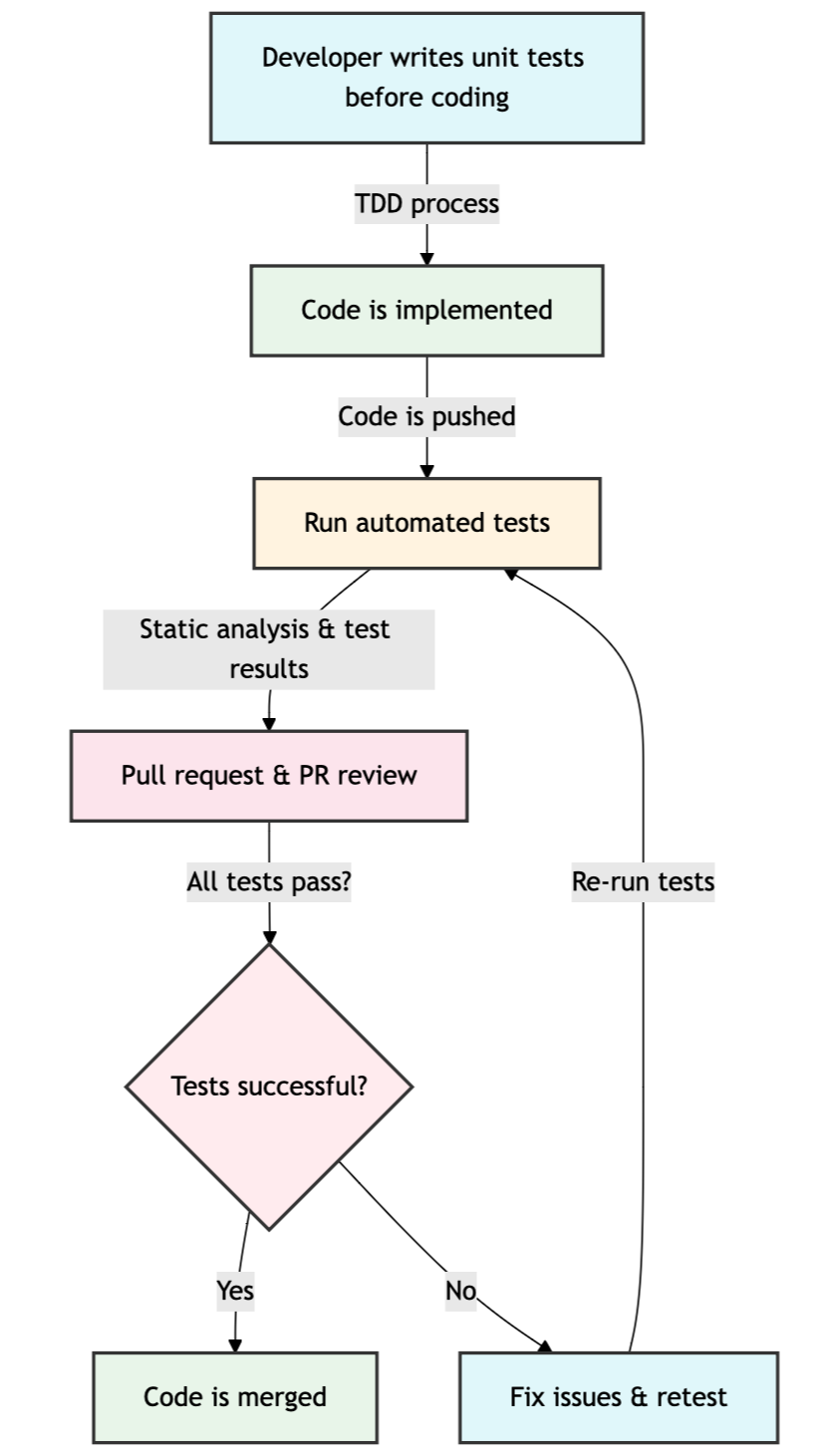
Shift left testing ensures quality by writing tests early, continuously updating them, running automated tests in CI/CD and validating code before merging.
Security (DevSecOps)
Goal: Detect vulnerabilities
Detecting vulnerabilities early in the software development life cycle is a key part of the shift left strategy. Here are some ideas on how we can detect vulnerabilities early and minimise security risks:
Integrate static application security testing (SAST):
- Use tools like SonarQube, Checkmarx or Fortify to scan the source code for issues like SQL injection, cross-site scripting (XSS), and insecure dependencies to analyse the code for security vulnerabilities before it even runs.
Shift security testing into CI/CD pipelines
- Incorporate static application security testing (SAST) into the CI/CD process to identify security issues as the application is being built or deployed, making it easier to fix vulnerabilities early.
Here is the step-by-step workflow we can follow for shift left security implementation:
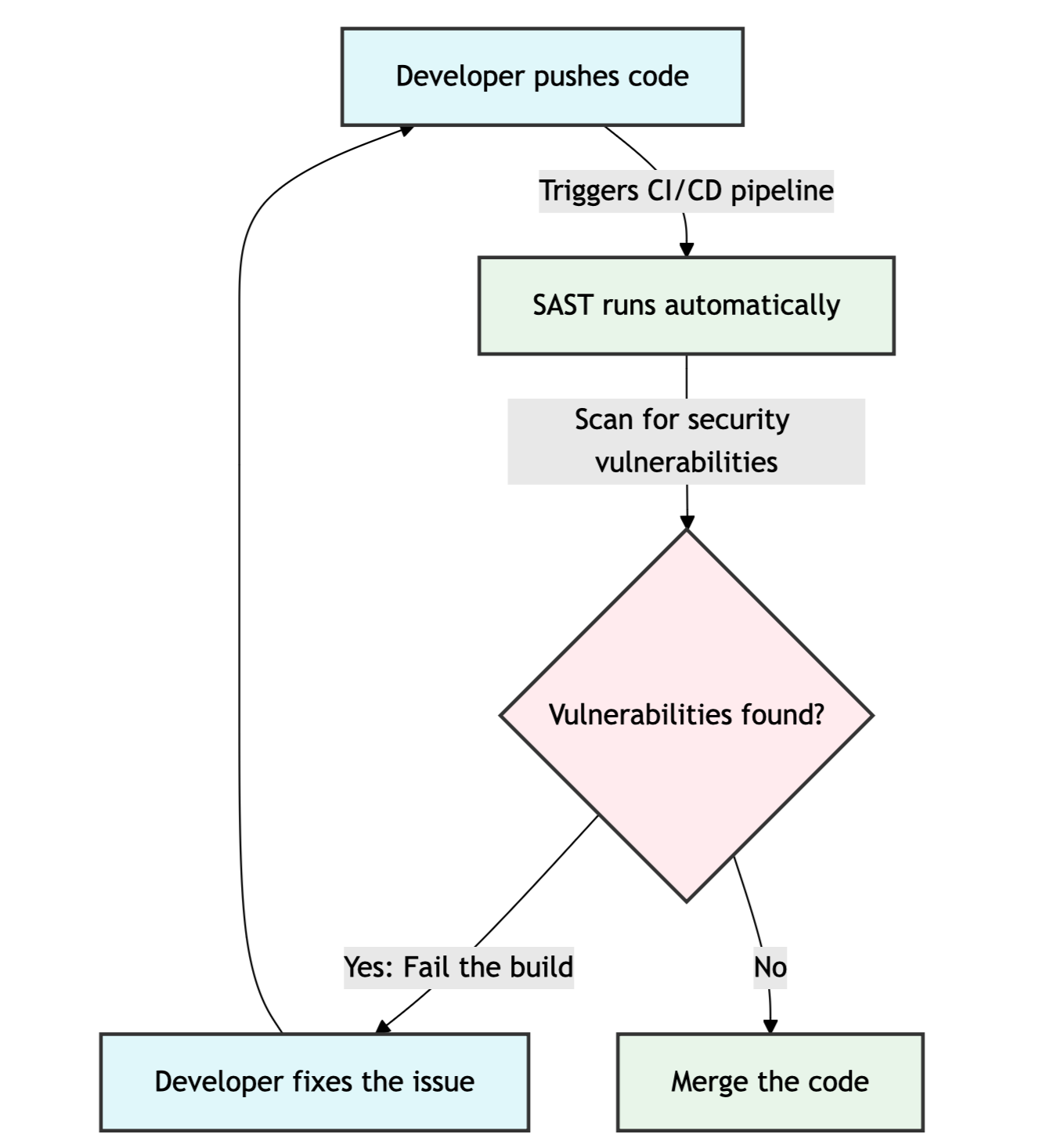
The process automatically scans for security vulnerabilities during the CI/CD pipeline, failing the build if issues are found, and allows merging only when no vulnerabilities are detected.
Performance and reliability
Goal: Detect performance bottlenecks early.
Implementing early detection of performance bottlenecks is essential for ensuring that applications perform efficiently as they evolve. Here are some ideas on how to detect performance issues early in the development process:
Integrate performance testing early in the development life cycle:
- Start performance testing during the development phase, not just at the end of the life cycle.
- Use tools like Autocannon, JMeter or Gatling for early load, stress and scalability testing to ensure the system can handle expected traffic loads from the beginning.
Automate performance testing in CI/CD pipelines
- Incorporate performance tests into the CI/CD pipeline so that they run automatically with every new build or code change for continuous monitoring of the performance.
Here is the step-by-step workflow we can follow for introducing shift left for performance and reliability
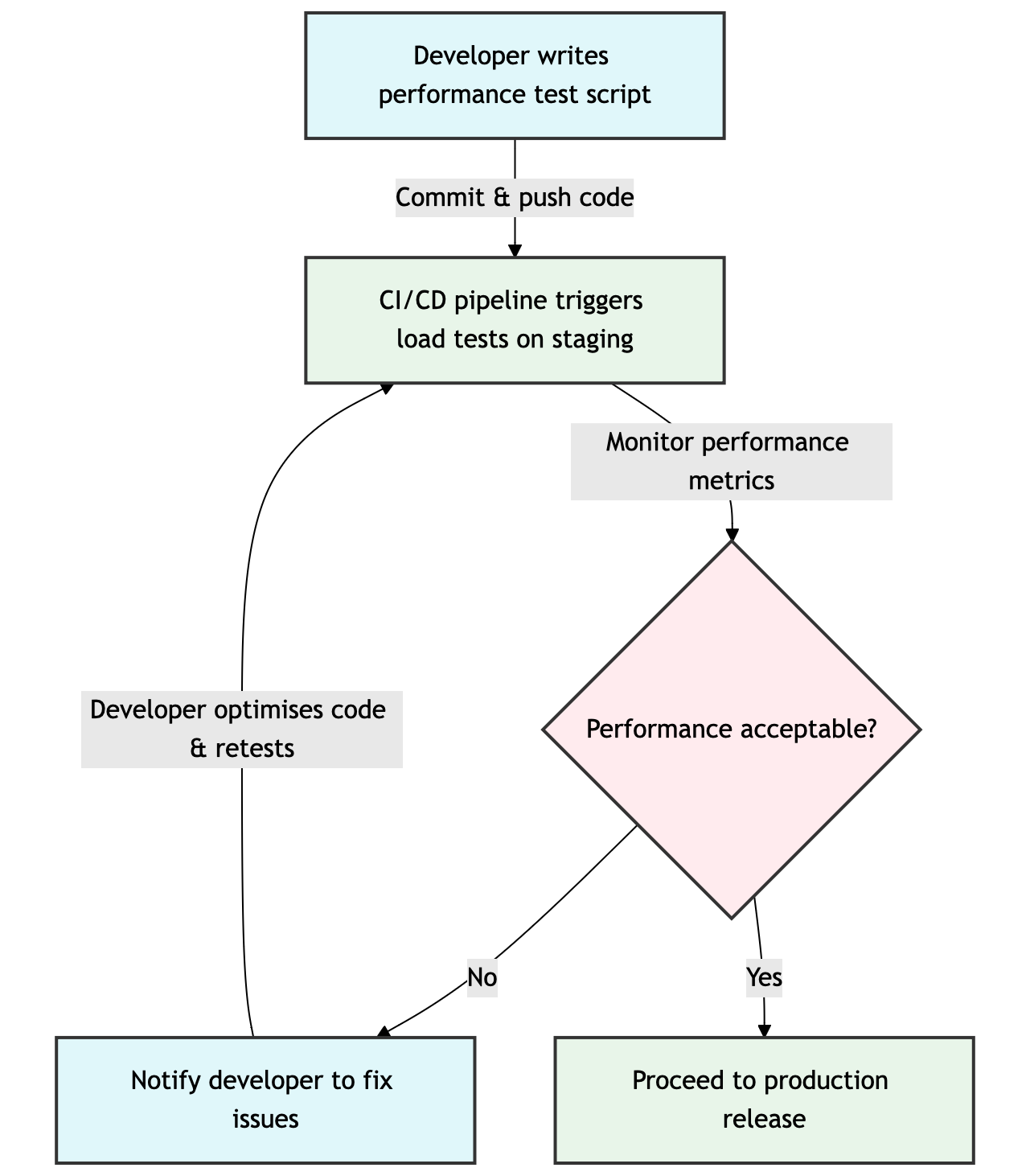
This process involves running load tests in the CI/CD pipeline, monitoring performance and notifying the developer to fix issues before proceeding to production if performance is unacceptable.
Compliance and accessibility
Goal: Ensure compliance with WCAG, GDPR and industry standards from the start.
Guaranteeing compliance early in development is key to a shift left strategy, helping avoid costly fixes and ensuring legal and accessibility requirements are met. Here are some ideas on how we can implement it:
Adopt compliance-driven development practices:
- Make compliance a part of the development culture from the outset by educating your team on WCAG, GDPR and other relevant industry standards.
- Integrate these standards into your coding guidelines and project documentation to ensure developers are aware of the requirements during the design phase.
Integrate accessibility and GDPR compliance assessments into your process:
- Incorporate accessibility testing into your code review process to ensure accessibility issues are caught early.
- Conduct data protection impact assessments (DPIAs) early in the project life cycle to evaluate how personal data is handled
Automated compliance checks in CI/CD pipelines:
- Integrate compliance testing into your CI/CD pipelines using tools like SonarQube, Checkmarx or WhiteSource to run automated checks for WCAG, GDPR and other regulatory standards at every stage of development
Here is the step-by-step workflow we can follow for implementing shift left for compliance and accessibility:
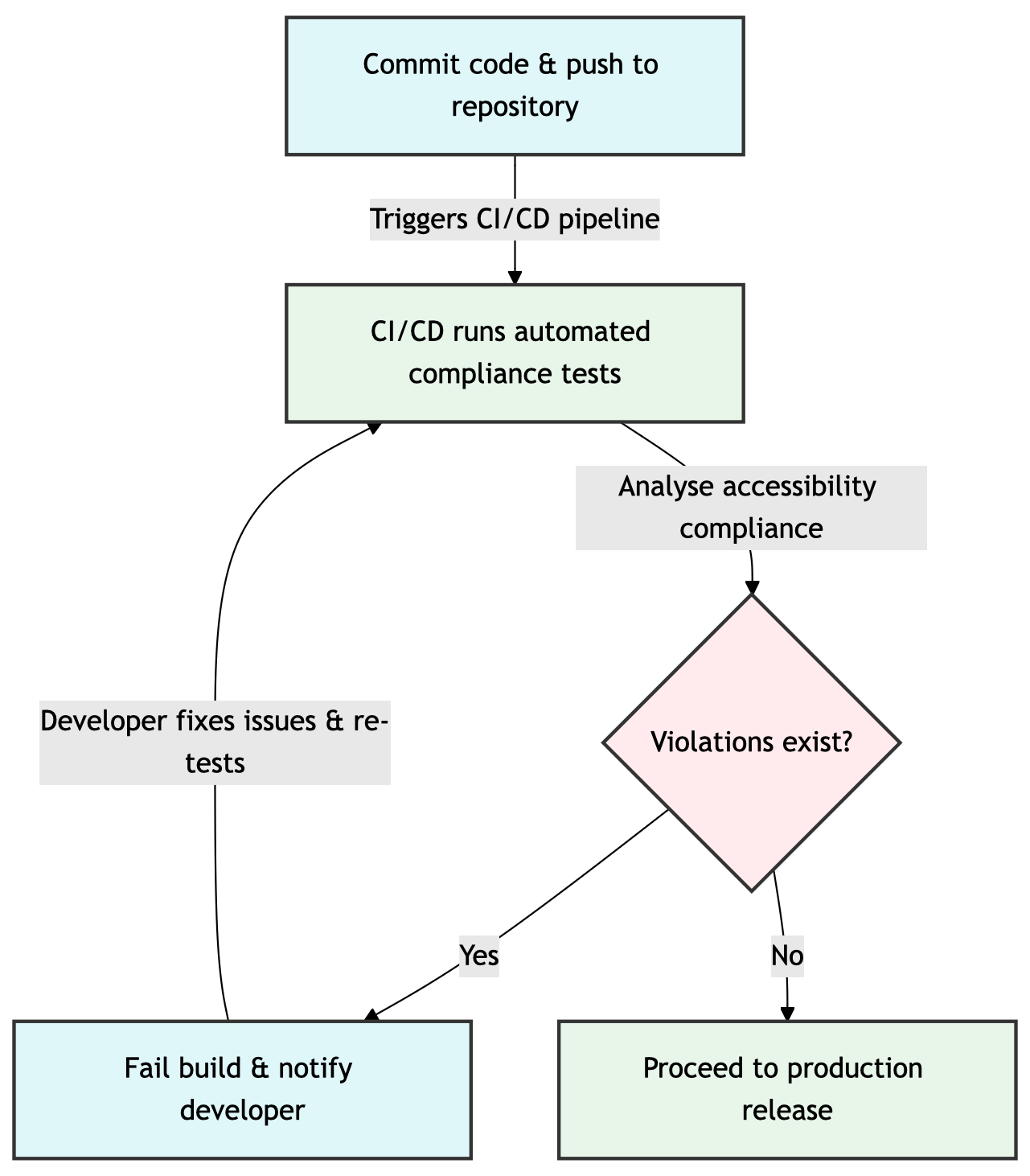
The process runs automated compliance tests during the CI/CD pipeline, failing the build and notifying the developer if compliance violations are found, before allowing production release.
Shift left delivers better product and team outcomes
So, to sum it up, based on the research and points mentioned above, we can confidently implement shift left techniques in the four key areas that will improve our process.
Implementing it reduces the need for rework, late-stage fixes and last-minute testing, which can all delay releases and add extra costs. Plus, with automated testing and early validation, we can reduce manual testing efforts, making the entire process more efficient and cheaper in the long run.
Shift left empowers QAs to work more closely with developers, creating a collaborative environment that ensures better outcomes for both the team and the product.
To embrace it as a core part of the development approach, start by focusing on one area, automate it in CI/CD and measure its impact. Then, gradually extend practices across all areas for continuous improvement.
But wait - there's more.
Nearform publishes real-world learnings on data & AI, engineering, and digital strategy - with more merged in weekly.
Insights
Perspectives on AI in engineering, product development, and strategy, for enterprise executives.
Community
Deep dives and tutorials by engineers, for engineers.
You may also like